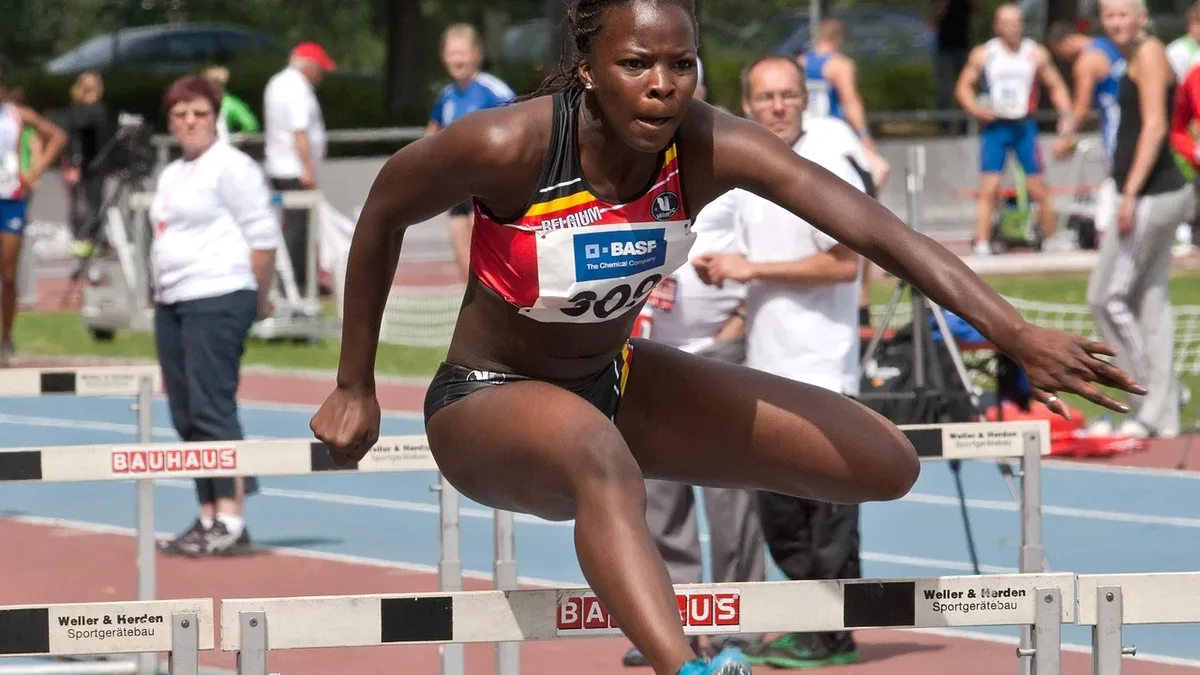
Hurdles
| Height | 91.4 cm (women's), 106.7 cm (men's) |
|---|---|
| Distance to first hurdle | 13.00 m |
| Number of hurdles | 10 |
| Hurdle spacing | 8.50 m |
| Distance from last hurdle to finish | 10.50 m |
| Technique | Lead leg, trail leg, sprinting between hurdles |
| Primary rule | Knocking over hurdles is permitted, no advantage gained |
Overview
Hurdles is a track and field discipline that combines sprinting with the clearance of barriers. Athletes race over a set distance on a track while navigating a series of ten evenly spaced hurdles. The objective is to complete the distance in the shortest possible time without violating technical rules, primarily by not deliberately knocking down hurdles or trailing a leg or foot alongside a hurdle. Standard distances include 110 meters for men and 100 meters for women, both featuring high hurdles, and 400 meters for both men and women using intermediate-height hurdles. The discipline requires a precise blend of rhythm, speed, power, and technical skill to minimize deceleration between barriers. It is a core event in major athletics competitions, including the Olympic Games and World Championships.
What to know
The hurdles themselves are lightweight, L-shaped frames designed to tip over if struck with sufficient force, which avoids dangerous falls but incurs a time penalty. The height of the hurdles varies by distance and gender: men's 110m hurdles are 1.067 meters high, women's 100m hurdles are 0.838 meters, and both genders use 0.914-meter hurdles for the 400m event. Hurdle spacing is rigidly fixed; for the 110m/100m events, the first hurdle is 13.72/13 meters from the start line, with 9.14 meters between hurdles and 14.02/10.5 meters from the final hurdle to the finish. The 400m hurdles pattern places the first hurdle 45 meters from the start, with 35 meters between hurdles and 40 meters to the finish after the last one. A runner is disqualified for deliberately knocking down a hurdle with a hand or foot, or for trailing a leg or foot outside the hurdle plane. The step pattern between hurdles, typically a three-step rhythm for high hurdles, is fundamental to maintaining race velocity.
Common questions
A frequent question is whether knocking down hurdles automatically disqualifies an athlete; it does not, provided the action is not deemed deliberate and the athlete attempts to clear each hurdle. Another common inquiry concerns the difference between the high hurdle and intermediate hurdle events, which extends beyond mere height to encompass the distinct speed-endurance demands and stride patterns required for the longer 400m race. Many ask about the optimal technique for clearance, which emphasizes a forward lean and a quick, snapping down action of the lead leg rather than a high, floating jump. Novices often question how to approach the first hurdle, which requires establishing an accurate stride pattern from the starting blocks to ensure a proper take-off point. People also commonly confuse the discipline with the steeplechase, which involves fixed barriers and a water jump on a longer circuit. Finally, spectators often wonder about training focus, which is split between developing flat sprint speed and honing the specific technical movements for efficient hurdle clearance.
Pros and cons
A significant pro of hurdles is that it develops a unique athleticism, combining linear speed, explosive power, coordination, and rhythmic timing in a way few other track events do. The technical challenge provides a continuous and engaging learning curve that can be mentally stimulating for disciplined athletes. However, a major con is the high risk of repetitive strain injuries, particularly to the hamstrings, hips, and knees, due to the extreme ranges of motion and asymmetrical forces involved in the clearance action. Many athletes regret specializing in hurdles if they lack innate flexibility or the specific neural coordination for the rapid leg mechanics, as these are less trainable than pure strength or endurance. The common technical mistake is over-jumping, where an athlete gains too much vertical height, sacrificing race speed and disrupting their stride pattern to the next hurdle. Furthermore, the event can be frustrating during skill acquisition, as minor technical flaws consistently lead to hitting barriers and breaking rhythm, which undermines confidence and race results.
Who it suits
This discipline best suits athletes who possess not only good sprint speed but also exceptional coordination and dynamic flexibility. It is ideal for competitors who enjoy a technical challenge and derive satisfaction from mastering a complex motor pattern rather than relying solely on raw power or endurance. Individuals with a background in gymnastics, dance, or other sports requiring rhythm and body control often transition well to the technical demands of hurdling. It suits disciplined athletes who are patient and meticulous in practice, willing to drill repetitive technique for incremental gains. The 400-meter hurdles, in particular, appeals to those with a strong blend of speed and stamina who can maintain composure and form under fatigue. Conversely, it is less suited to athletes prone to frustration with technical detail or those with a history of soft tissue injuries that could be exacerbated by the event's specific demands.
Latest Hurdles news
Latest reporting
Ja'Kobe Tharp's rollercoaster season
World record holder Ja'Kobe Tharp discusses the intense competition in men's 110m hurdles, marked by his own record-breaking 12.75 and a shocking...
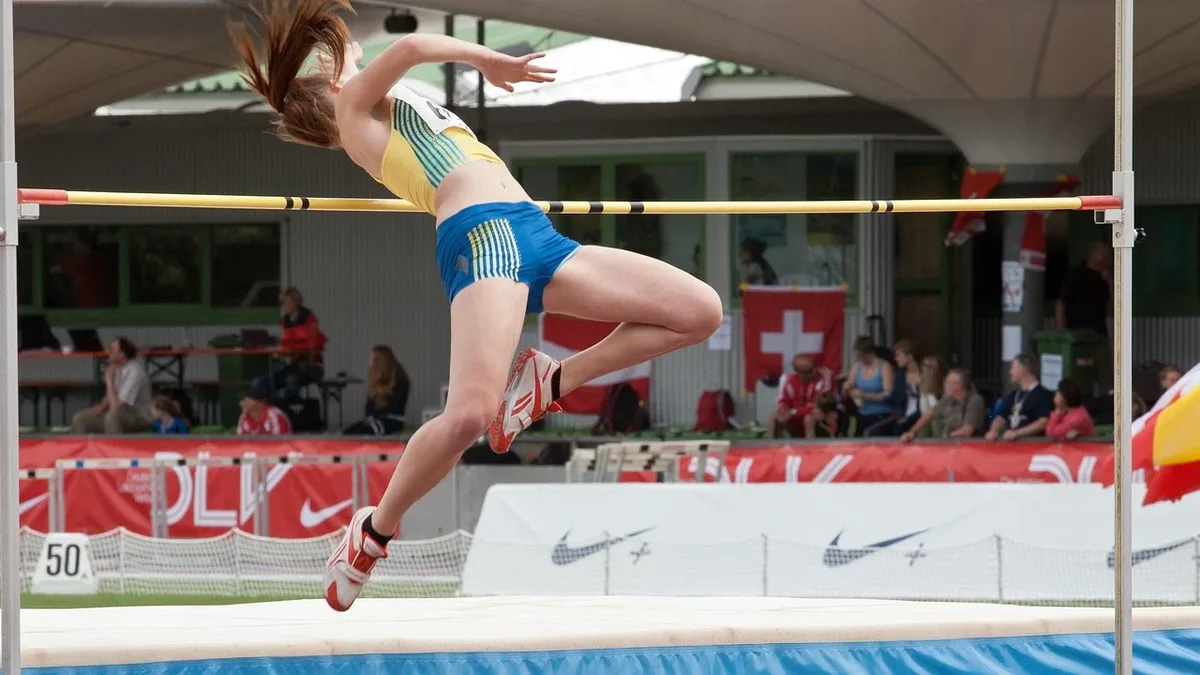
Masai Russell breaks 100m hurdles world
Masai Russell set a women's 100m hurdles world record of 12.09 seconds in Zürich, breaking Tobi Amusan's mark.

Dos Santos breaks 400m hurdles world record
Alison dos Santos broke the 400m hurdles world record with a time of 45.80 seconds at the Weltklasse meet in Zürich, cementing his dominance this...
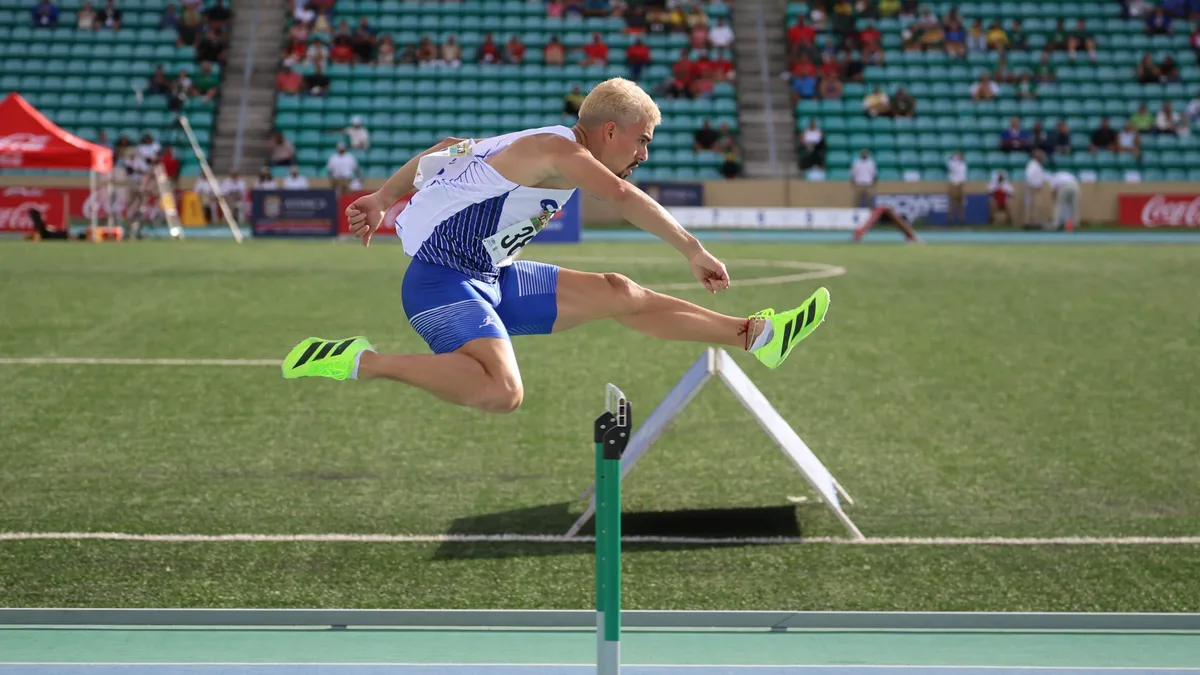
Dos Santos breaks 400m hurdles world record
Alison dos Santos of Brazil broke Karsten Warholm's world record in the 400m hurdles, clocking 45.80 at the Weltklasse meet in Zurich on August 27.

Euro Champs Day 3 Recap: Hudson-Smith Wins Third 400m Gold, Zapletalová Takes 400H Title
Matthew Hudson-Smith secured his third 400m gold medal at the Euro Champs, while Emma Zapletalová dominated the 400m hurdles to claim the title.

Audrey Werro Claims European 800m Gold in Thrilling Duel with Keely Hodgkinson
Audrey Werro secured her first major title with a championship-record 1:54.81 in the European 800m final, outpacing defending champion Keely...